2D, 2.5D and 3D MUGEN-style fighting explained
2.5D usually describes 3D presentation combined with largely planar fighting, while 3D fighting can also involve depth movement. Check rendering, movement and asset compatibility separately when comparing MUGEN-style games.
Three different questions hide in one label
When a player asks whether a fighter is “2D or 3D,” they may mean the artwork, the camera or the movement rules. A sprite rendered inside a 3D scene is not automatically a traditional flat-screen fighter. Likewise, a fully modeled character can still fight along a mostly fixed plane.
Treat 2.5D as a descriptive convention rather than a guaranteed file format or compatibility standard. It often means three-dimensional presentation with largely planar fighting, but individual games use the label differently. The useful question is what the current game lets you do.
| Question | What to inspect |
|---|---|
| How is it drawn? | Sprite art, voxel geometry, models, lighting and stage depth |
| How do fighters move? | Planar movement, depth movement, sidesteps and target behavior |
| What does the camera do? | Fixed side view, tracking, rotation and transitions |
| What can it import? | Explicit supported assets and logic, not the visual label |
Where K.O.R.E. fits
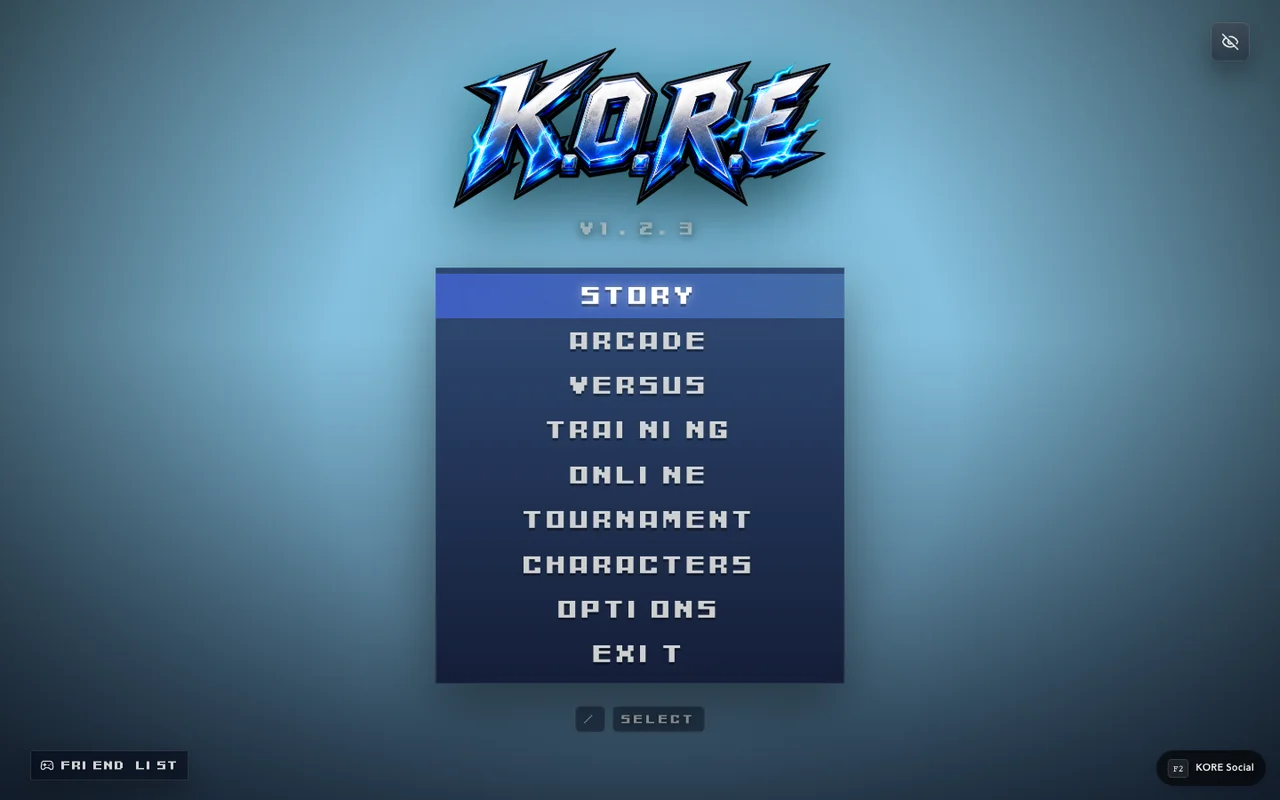
K.O.R.E. is an independent browser-based 3D roster fighter. Its source has its own movement, targeting, rendering and character definitions. The roster pipeline includes sprite-derived content and voxel assets; that does not make the runtime the original MUGEN engine.
Try a short session to understand the combination. Watch how the fighter moves relative to the opponent, how the camera presents spacing and which inputs change depth or direction under the selected scheme. The controls guide is a better reference than guessing from another fighter's button layout.
Why the distinction matters for creators
A MUGEN stage background and a K.O.R.E. stage definition do not represent the same data in the same way. K.O.R.E.'s inspected stage conversion parses selected source information and builds its own stage/prop structures. That is a translation workflow, not proof that every authored behavior transfers.
The same caution applies to characters. Images, animation frames, collision and move logic each need the right representation. “3D MUGEN” is useful search language; it is insufficient as an import specification.
Pick by the experience you want
If you want to play immediately, open K.O.R.E. and test a selectable fighter. If you want to move an existing project between engines, read compatibility first and make a small verified conversion before committing to a whole roster.
Sources & verification
View the research record
Coverage: Named source passages inspected; practical routines are original advice. Production entry and selected source comparisons are recorded separately. No whole-roster, full-campaign, physical-device or universal network certification.
First-party facts: Named runtime/source passages and the selected live entry checks recorded here. Original additions: Explanations, comparison framing and practice routines. Gaps: No full-campaign, whole-roster, universal device or network certification. Development tooling is distinct from public capabilities.
Source review: October 20, 2026. Public claims remain bounded by the scope of each source.
- kore app
Inspected menu, mode and importer source. Character import and MUGEN stage import POST to /__kore/dev/ endpoints. Source inspection is not a complete production compatibility test.
Inspected named local source passages and public response; bounded coverage below.
Inspected source fingerprint:
c91886ba1e3ebc951e3c3ef50356cfe64fb2718164bdccf7ea59d636960160ae. Public response fingerprint:38cc2f2a18a415a64a9cea8d0af2880043ff8c826d00f37d973b5f28e0f80d9d. Local source and public response differ or are different representations; no complete build equivalence is claimed.- kore controls
Default P1 WASD, U/I/J/K, Space, O, Enter, Escape. Saved settings override defaults.
Inspected named local source passages and public response; bounded coverage below.
Inspected source fingerprint:
a43e1af0089e4842e93e70366e9bacf900676cca35043247914f50f198224d7f. Public response fingerprint:38cc2f2a18a415a64a9cea8d0af2880043ff8c826d00f37d973b5f28e0f80d9d. Local source and public response differ or are different representations; no complete build equivalence is claimed.- kore mugen
DEF/background parsing and sprite-to-stage conversion, distinct from character CNS/CMD emulation.
Inspected named local source passages and public response; bounded coverage below.
Inspected source fingerprint:
8fc75a8372213139824755479575a59d4ffb2fe1f9154abfb966d90d8e760660. Public response fingerprint:38cc2f2a18a415a64a9cea8d0af2880043ff8c826d00f37d973b5f28e0f80d9d. Local source and public response differ or are different representations; no complete build equivalence is claimed.
Article fingerprint: 6ff0e6dbd03c760832eda384cdbdefafa1f8b1fba924c09698cbbae73fc24ff4.